
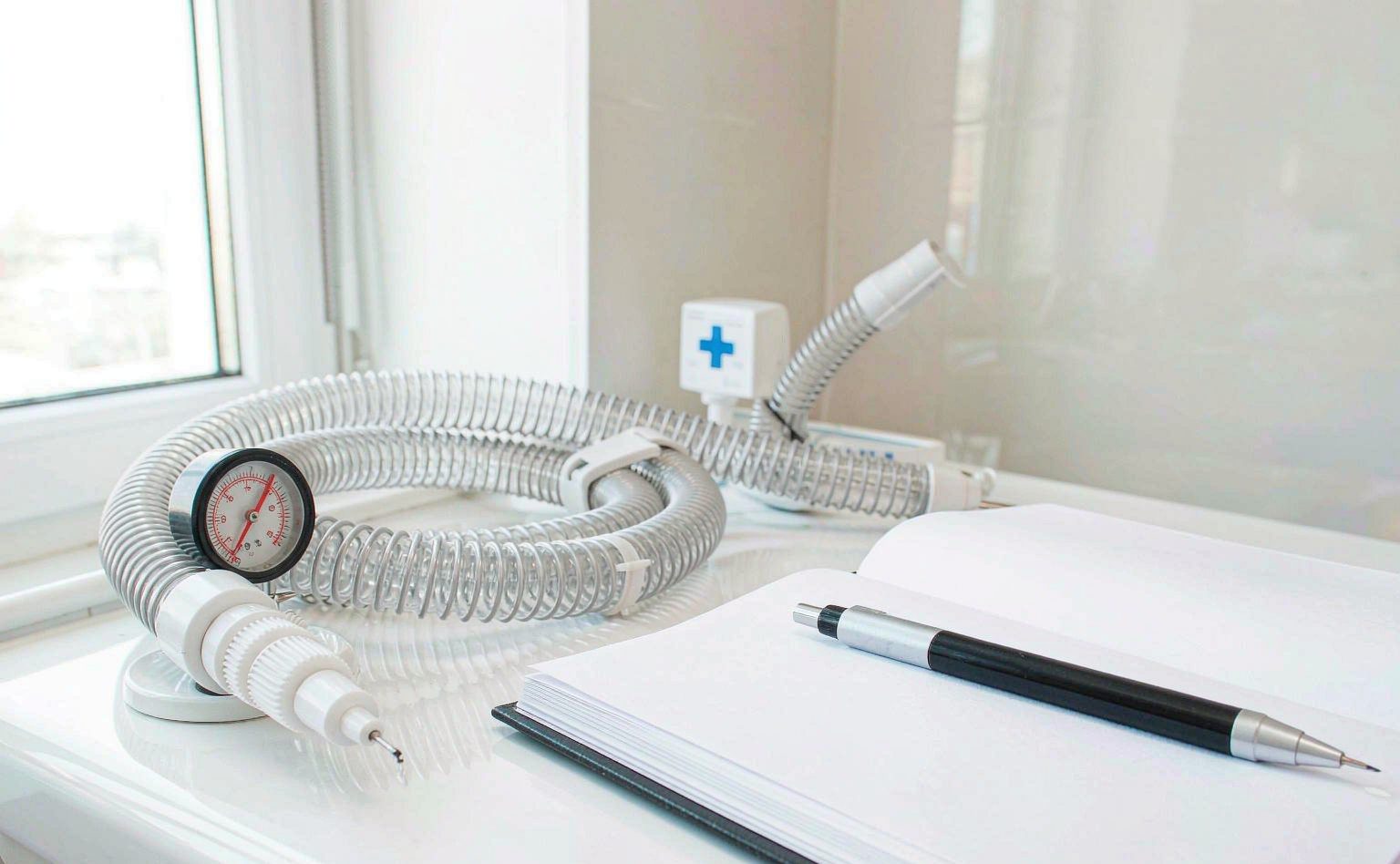
High-speed handpieces are often sold on one number: free-running rpm. It is the easiest figure to print on a catalogue page and the least useful one for predicting how a turbine behaves in a mouth. Two other quantities — airflow and pressure at the instrument — explain far more of what a clinician actually feels.
What CFPM actually measures
CFPM stands for cubic feet per minute: the volume of drive air a handpiece consumes at a stated supply pressure. It is a flow figure, not a speed figure and not a power figure. A turbine with a higher CFPM rating generally moves more air through its rotor, which usually means more torque available under load — provided the unit can actually deliver that flow.
The qualification matters. A compressor that meets its specification at the wall may not maintain it after a narrow hose, a restrictive coupling and a partially blocked line. The handpiece then receives less air than the catalogue assumed, and the extra CFPM capacity on paper never appears in use.
Four figures, four different questions
| Figure | What it answers | What it does not answer |
|---|---|---|
| Free-running rpm | How fast the rotor turns with no load at a stated pressure | How well it cuts; how much torque remains under pressure |
| CFPM | How much drive air the turbine consumes at that pressure | Whether the unit can supply it; the torque at the bur |
| Stall torque | The force at which rotation stops under load | How the turbine behaves at normal working speeds |
| Pressure at the handpiece | What the instrument actually receives after the hose and coupling | Anything about the turbine's own design |
None of these figures is wrong. They answer different questions, and a comparison only becomes meaningful when the same conditions apply to every product in it. If a catalogue quotes rpm without a pressure, or CFPM without a reference condition, there is nothing solid to compare.
Pressure and flow are not the same thing
It helps to picture the airline as a water pipe. Pressure is how hard the air pushes; flow is how much of it gets through. A narrow line can hold good pressure while delivering too little volume to feed a high-flow turbine. Once the bur touches tooth structure, rotor speed drops and the motor or compressor has to supply flow quickly to recover.
- Pressure too low: the turbine spins slowly even with no load, and the symptom appears on every bur.
- Flow restricted: free-running speed may look normal, but the turbine slows sharply under light cutting load.
- Exhaust restricted: spent air cannot leave freely, so effective drive pressure falls and the head runs hot.
That is why a handpiece that "lost power" is not automatically a handpiece that needs a new cartridge. The free checks come first — see repair or replace for the order we recommend.
Measure at the instrument, not at the unit
- Fit a pressure gauge at the handpiece end of the line, with the coupling in place.
- Run the air with the handpiece connected but not cutting, and record the static reading.
- Repeat with the turbine running, because a restricted supply shows up as a bigger drop under flow.
- Compare with the manufacturer's specified range for that exact model, not a generic figure.
- If the reading is low, swap the hose and the coupling insert before considering the handpiece itself.
If free-running speed is correct but the turbine stalls under ordinary cutting, suspect flow, exhaust or the bur before the cartridge. If both free-running speed and load speed are low across several instruments, suspect the supply. Only when one instrument differs from its healthy twins does the turbine itself become the leading suspect.
Airflow, water spray and mist
Drive air leaves the head through its exhaust, close to the water spray. Too much exhaust velocity, a misdirected spray port or a worn air cap can blow the water away from the bur tip rather than onto it. The result looks like a water problem but is really an airflow problem.
Check the spray pattern with the bur fitted and the handpiece running. A coherent stream reaching the tip is the goal; a fan that disperses before the tip is not. Clean the ports according to the IFU and use only the cleaning tools the manufacturer approves — a wire that is too large will permanently change the spray geometry.
Three common misreadings
- "More CFPM means better." It means more air consumed. On a unit with limited capacity, that can become a liability.
- "The unit gauge says 2.5 bar, so the handpiece gets 2.5 bar." The gauge is upstream. Losses between it and the rotor are invisible.
- "Slow cutting means worn bearings." Bearing wear usually starts as noise and vibration. Pressure, spray and bur condition deserve the first look.
For the vocabulary used in these specifications, the air turbine glossary defines each term in isolation. For the wider purchase decision, see air vs electric.
Common questions
Does a higher CFPM figure always mean more cutting power? Not by itself. It means the design consumes more air. Power at the bur also depends on rotor efficiency, bearing condition, pressure at the instrument and the bur being used.
Can a new turbine still feel weak? Yes. If the supply or exhaust is restricted, a new cartridge will reproduce the same symptom. Check the supply before exchanging the instrument.
How often should pressure be checked? When symptoms appear, after hose or coupling changes, and as part of a periodic unit check. Requirements vary, so follow the manufacturer's service schedule for your equipment.
Pressure ranges, spray settings and cleaning methods differ between models. This article explains relationships between figures; it does not set operating parameters. Use the instructions for use for your exact handpiece and dental unit.