
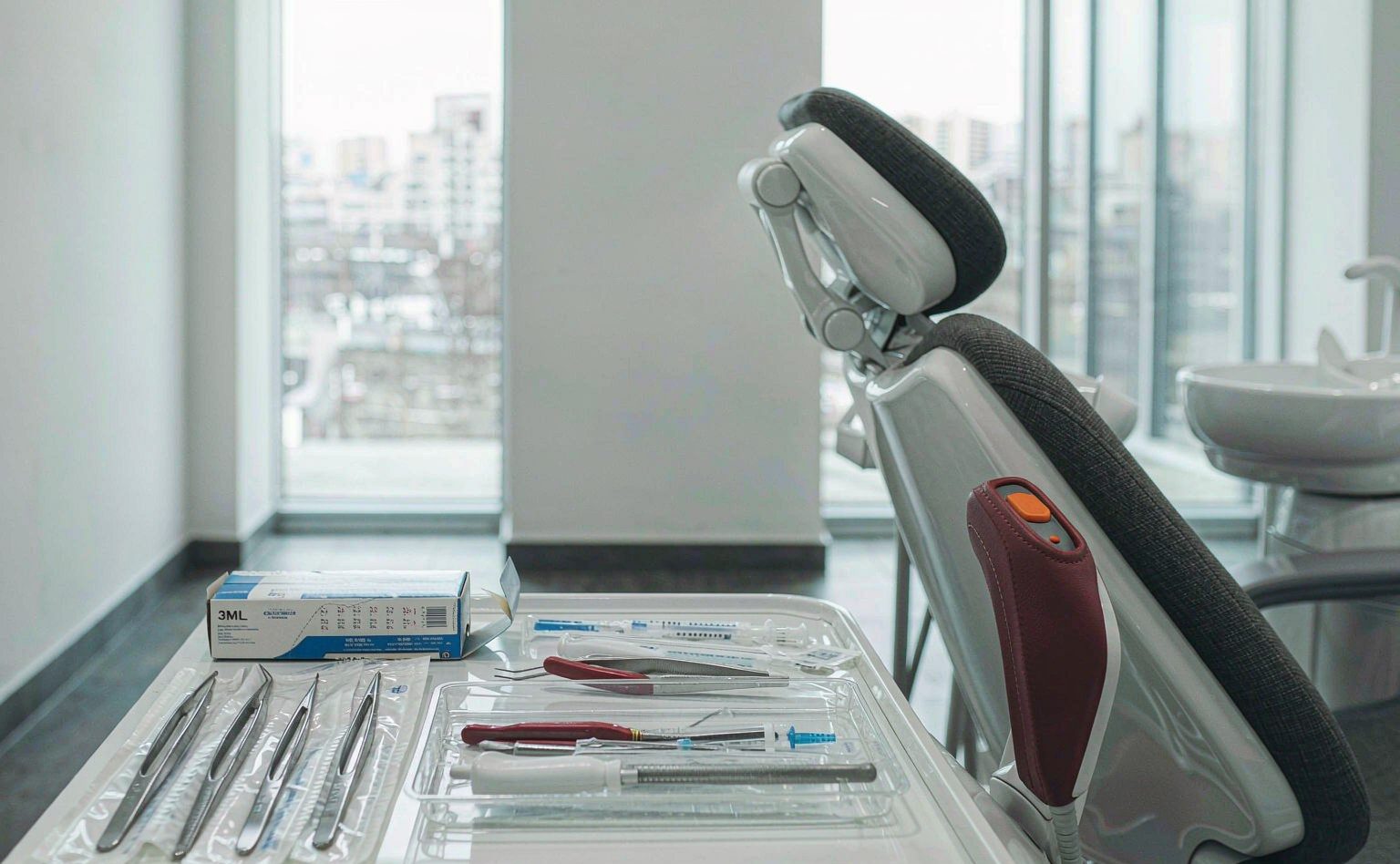
Surgical and implant handpieces look like relatives of restorative contra-angles, but they are engineered for a different job: cutting bone with precise, limited torque, under irrigation, in a sterile field. Nearly everything that makes them special follows from those three requirements — and most of what fails on them follows from treating them like ordinary handpieces.
The 20:1 contra-angle
The standard implant contra-angle is a 20:1 reduction gear head: it turns roughly 1,500 rpm at the bur from a motor running at 30,000 rpm. At that speed, torque is high and controllable, and heat generation in bone stays manageable — which is the whole point. Compare this with the 1:5 speed-increasing heads used in restorative work; the two are opposite answers to opposite problems. See contra-angle ratios for the arithmetic.
- Low speed, high torque gives the operator feel: the handpiece slows under load instead of spinning through, which is exactly the feedback wanted near bone.
- Gear heads are precision assemblies. A 20:1 head contains more gear stages than a 1:1 or 1:5, and it is correspondingly more sensitive to debris, impact damage and lubrication errors.
- They are not interchangeable across brands by feel. Mounting and drive geometry vary; check the motor manufacturer's supported attachments before buying.
Irrigation — the system within the system
Implant and surgical handpieces deliver sterile irrigation to the surgical site, usually through channels in the attachment ending at or around the bur. Two designs exist, and mixing them up is a classic ordering error:
- Internal irrigation — fluid travels through the attachment and exits at the head, aimed at the cutting area.
- External irrigation — fluid runs along tubes on the outside of the attachment.
The irrigation path is also the most failure-prone part of the system: it clogs with dried saline and debris like any narrow channel, and its O-rings and connections are service items. Flush and maintain it per the IFU — a blocked irrigation channel during surgery is discovered at the worst possible moment.
Torque control and safety functions
Implant motor units let the operator set a torque limit. When resistance exceeds the limit, the unit cuts power or reverses briefly — the auto-reverse (or autotreverse) function — to prevent the handpiece from wrenching in the surgeon's grip or over-torquing the site. Three practical consequences:
- The attachment must be correctly identified in the unit for limits and auto-reverse to behave as designed — the same point made in electric motors and attachments.
- Calibration matters. If torque output is in doubt, the unit and motor should be checked by the manufacturer's service route rather than trusted.
- Symptoms like stalling or unexpected reversal can be settings, not faults — verify the configured limit before sending anything for repair.
Sterile processing is stricter
| Aspect | Restorative routine | Surgical routine |
|---|---|---|
| Reprocessing | Clean, lubricate, autoclave per IFU | Same discipline, plus the sterilizer parameters and wraps required for surgical instrumentation |
| Lubrication | Per IFU schedule | Critical for geared heads — under-lubrication shows up quickly as rough running |
| Irrigation lines | Narrow water spray channels | Dedicated irrigation channels that must be flushed and dried to prevent blockage and corrosion |
| Consequence of wear | Poor cutting quality | Potentially a compromised surgical procedure — these instruments justify conservative retirement |
A restorative handpiece that is "a bit rough" is an inconvenience. A surgical handpiece with worn bearings, uncertain torque or a suspect irrigation path is a case-management risk. Most teams retire surgical instruments at the first persistent symptom rather than running them to failure.
What fails, and how it shows up
- Rough or noisy gear head — gear wear or lubrication failure; the head is usually serviceable or replaceable depending on brand.
- Weak or absent irrigation — blocked channel, failed O-ring, or a kinked external tube; clean and retest before condemning the attachment.
- Chuck or bur slippage under load — worn chuck or debris; surgical burs and the high torque involved make this a stop-use symptom.
- Overheating — as with any instrument, heat plus bearing wear is a stop-use combination.
Common questions
Can I use a 20:1 attachment for regular restorative work? It will run, but at speeds suited to bone work, not to conventional cutting — the wrong tool in both directions. Use each head for its designed job.
Are surgical handpieces autoclavable? The handpiece and attachment generally are, per each part's own IFU; some motor components may be wipe-only. The IFU for each specific part is the authority.
Why does my implant motor keep tripping auto-reverse? Most often the configured torque limit is genuinely being reached — check bur condition, speed setting and the attachment selection in the unit. Persistent tripping with an obviously free-running bur points to a motor or calibration problem and deserves the manufacturer's service route.
Related reading
- Contra-angle ratiosWhat 20:1, 1:5 and 16:1 actually do to speed and torque.
- Electric motors and attachmentsThe system these heads clip into, and how compatibility works.
- Sterilization and reprocessingThe processing discipline surgical instruments depend on.