
Handpiece industry roundup: November 2026
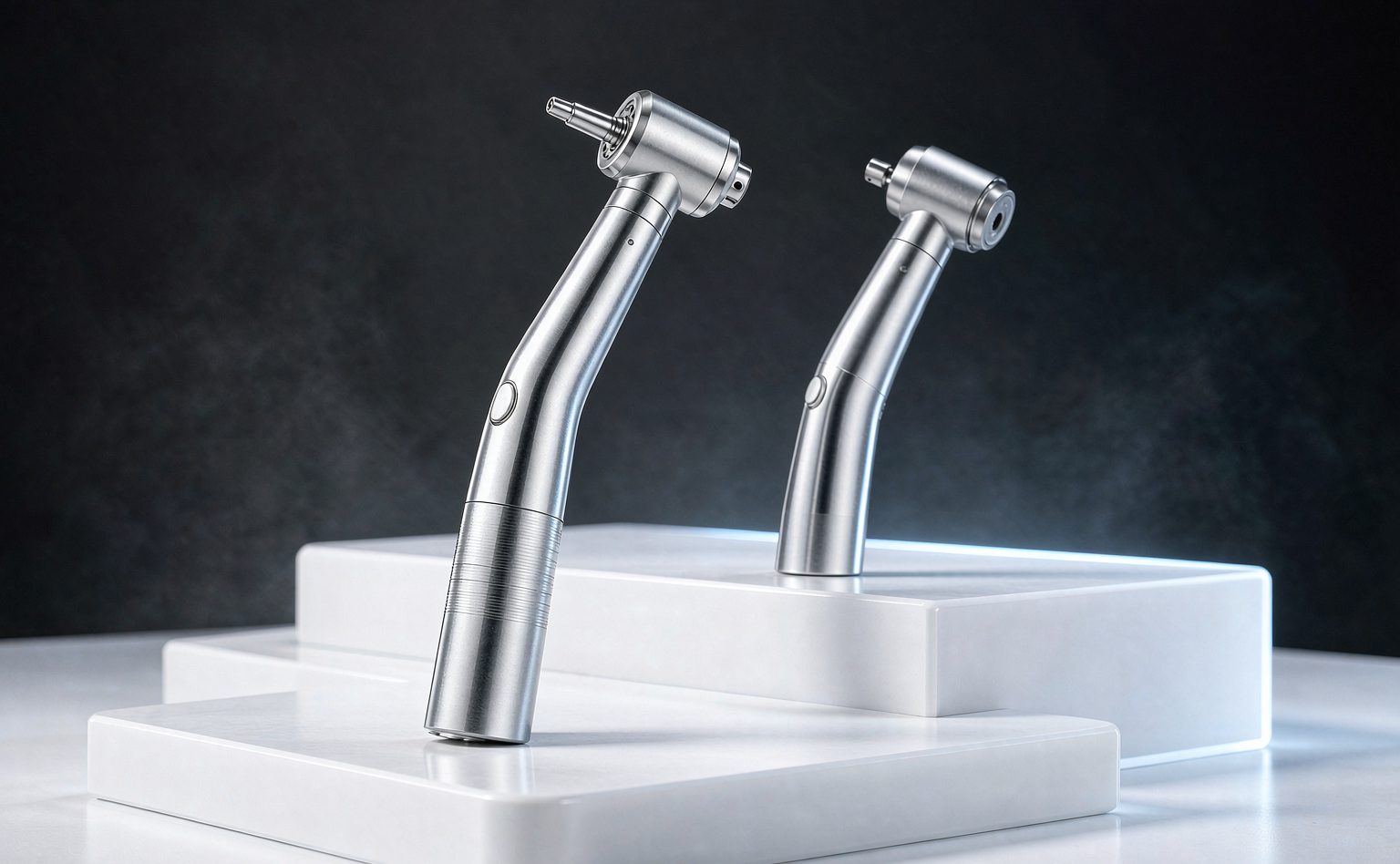
This month's theme is value without new moulds: manufacturers are upgrading existing lines in place, competing on published power figures and warranty length rather than launching all-new families. Plus: the maintenance trap that keeps showing up on repair benches.
W&H upgrades the Synea Fusion in place
W&H has announced a significant refresh of the Synea Fusion turbine — its value-oriented line — and the interesting part is what did not change: the model family and, per the company's positioning, the price idea. The upgrade brings cutting power up to 29 watts (measured according to ISO 14457), adds the Power Blade rotor already seen on the Synea Power Edition, and applies the ScratchBlocker coating, a liquid-repellent surface treatment intended to resist scratches and make decontamination easier. The warranty on the line is extended to two years.
Synea Fusion remains available in two head sizes, with or without light, across Roto Quick, MULTIflex-compatible and fixed connections — which is exactly why this matters beyond one product page. The most common real-world purchase in general practice is not a flagship turbine; it is a dependable mid-line unit that fits the coupling already on the chair. When the value tier gains flagship specs, the entire price-performance conversation shifts. Buyers comparing quotes this quarter should re-check the revision status of the Fusion line rather than relying on older spec sheets.
For context on how W&H's two Synea lines now differ, see our W&H model reference and the brand directory warranty table.
The wattage race — and what the numbers actually say
Published output figures keep climbing, and it is worth putting them side by side. W&H now quotes up to 29 W for the upgraded Synea Fusion. KaVo's EXPERTtorque turbines are listed at approximately 29 W at 3.5 bar. StarDental's 430 Torque Flex is rated at 31 W with a 340,000 rpm no-load speed. And Morita's TwinPower Turbine G-Series, the current flagship of that family, is quoted at up to 47 W.
Two caveats belong next to every one of those numbers. First, they are laboratory measurements taken under ISO 14457 at stated supply pressures — a chairside unit fed by an ageing compressor, a partially clogged filter or a long narrow tubing run will not reproduce them. Second, power at the bur is only one input into cutting efficiency; head size, spray quality, chuck grip and balance determine how much of that power you can actually use. A rising number on a brochure is a reason to look closer, not a reason to buy. Our new guide on reading a handpiece spec sheet walks through each published figure and what it does and does not tell you.
NSK leans on warranty length at the top of the electric range
NSK's Ti-Max Z99L — the new flagship of its electric contra-angle line — pairs a titanium body with the DURAGRIP non-slip surface, a revised DURAPOWER chuck for bur retention, Quattro spray and a two-way water function that switches between jet and mist irrigation. The marketing headline, though, is the "3-Year Worry-Free Warranty" — the longest standard term NSK applies to a handpiece in its European materials, where most Ti-Max lines carry two years.
Warranty length has quietly become a competitive spec. W&H extended Synea Fusion to two years this month; KaVo's premium lines run 24 months with extension programs; Bien-Air and NSK both stretch to 36 months on selected motors and series. For practices, the meaningful comparison is not the headline number but the conditions attached — who may service the unit, what maintenance is required to keep the term, and what is excluded. Our warranty-at-a-glance table keeps those terms side by side.
From the repair desk: the LubeFree trap
Independent repair services keep reporting the same self-inflicted failure on StarDental turbines, and it deserves a wider audience. The LubeFree 430 family runs sealed bearings designed never to see oil. Lubricate one — even once, even accidentally through an automatic lubricator on a shared line — and those sealed bearings are compromised. The manufacturer's stated position is unforgiving: once oiled, the unit must continue to be lubricated for the rest of its service life.
The trap is visual: LubeFree and lubricated turbines look nearly identical on a tray, and the model suffix does not help — SW and SWL describe optic configuration (SWL is the fibre-optic head), not lubrication. Two practical defences: label your handpieces by turbine type at the practice level, and check what your automated maintenance system is actually connected to. A single shared oil line can shorten a LubeFree head dramatically. Our maintenance guide covers lubrication practice per drive type.
What to watch
Year-end meeting season is underway, and Q4 promotional cycles typically bundle handpieces with maintenance systems — the same bundles that anchor extended-warranty programs. If a quote this quarter includes free goods or an extended term, note the conditions now, not at claim time. We expect further in-place refreshes on the value tier as the spec-upgrade strategy spreads; we will track them here.
Sources: manufacturer newsrooms and product materials from W&H, NSK, KaVo, Morita and DentalEZ/StarDental, checked November 2026; figures are as published by each manufacturer and subject to regional variation.
Related on handpiece.com
- Reading a handpiece spec sheetWhat watts, rpm, head size and noise figures really tell you.
- Brand directoryOfficial service channels and warranty terms side by side.
- October 2026 roundupThe safer-repairs campaign, FDA clearances and market outlook.